
SOLUTIONS
Pet Travel
Focused on shipping, boarding and venue check-in, this centers on identity, behavior and emotion recognition to build a trusted identity record and status log across the whole travel journey — solving hard verification, invisible status and unclear liability.
Industry pain points
Pets get highly stressed in cars
Most pets naturally fear unfamiliar moving spaces. In the car, they may tremble, pant, bark, vomit from motion sickness or show other stress reactions, affecting driving safety and pet health. Surveys show that nearly 30% of pet travel accidents are caused by the lack of intelligent vehicle monitoring.
Emotional state cannot be sensed
Drivers cannot see the emotional state of pets in the back seat in real time. By the time something seems wrong, the pet may already be motion sick, anxious or even vomiting.
Pets can be forgotten in the car
If an owner gets out briefly, a pet may be left in the vehicle by mistake. In summer heat, the cabin temperature can reach dangerous levels within minutes.
In-vehicle systems do not fit pets
Car air conditioning and multimedia systems are designed around human comfort and cannot dynamically adapt to a pet’s emotional or physiological state.
Multi-pet travel is hard to manage
When several pets travel together, it is difficult to tell them apart or predict agitation or conflict between them.
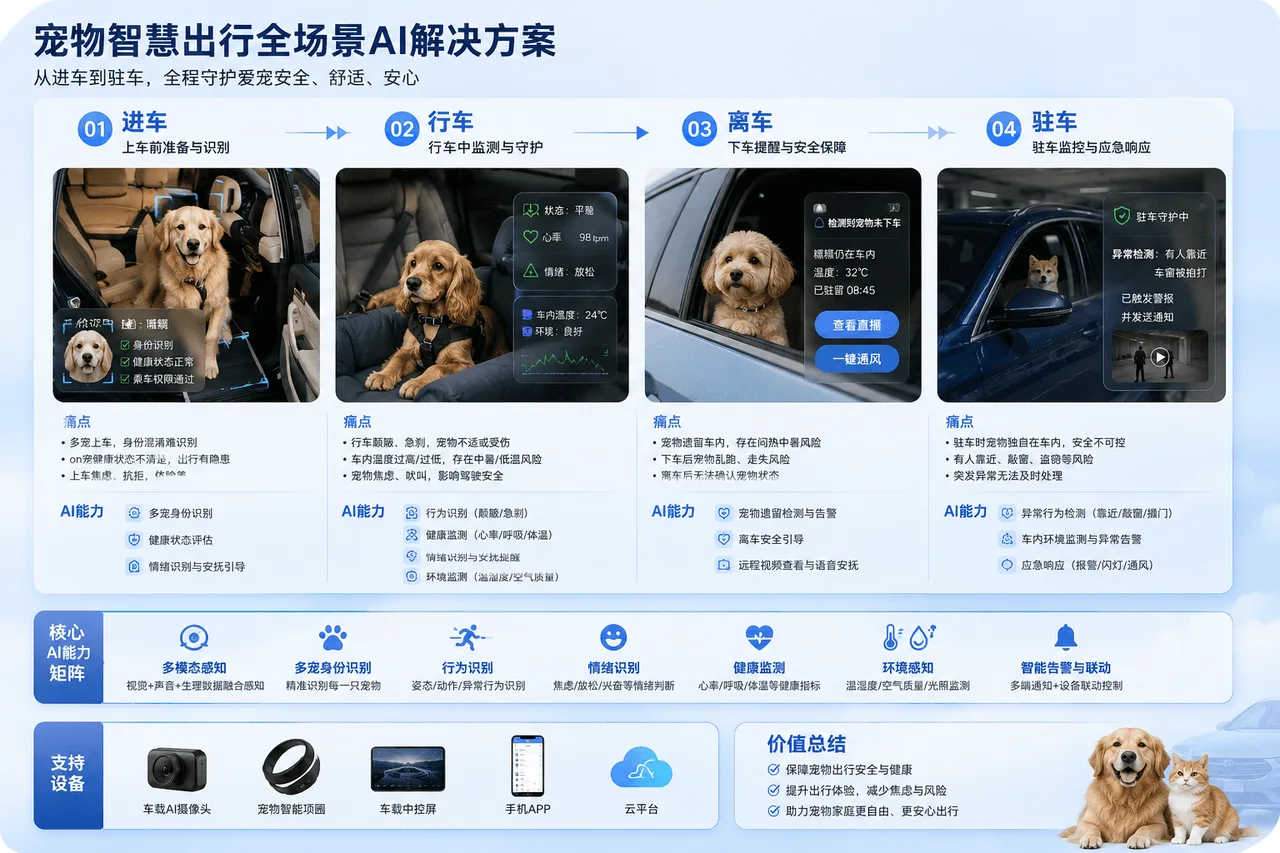
Solution architecture
Business value
Full cycle
Protect pet travel safety with full-cycle AI monitoring and alerts, minimizing incidents caused by oversight.
-30%~40%
Ease travel anxiety with personalized soothing and real-time emotion adjustment, significantly reducing motion sickness and stress reactions.
More focused
Reduce the owner’s travel burden. AI monitors in real time and proactively alerts on anomalies, making driving safer and more focused.
Better experience
Upgrade the human-pet travel experience from “going out with pets is a hassle” to “going out with pets is enjoyable”, expanding travel range and scenarios.
Differentiated
Help automakers upgrade smart cabins and build differentiated competitiveness for pet-friendly vehicles.
Key Features
Full-cycle coverage
The first pet-travel AI solution to cover pre-trip, on-trip, parked and after-leaving scenarios.
Multimodal fusion perception
Visual, audio and physiological data are fused for much higher emotion-recognition accuracy than single-source solutions.
Low-latency edge inference
With lightweight algorithms and edge computing, models can run on in-vehicle terminals in real time without cloud dependence.
High-precision individual recognition
Even with multiple pets in the vehicle, changing light or partial occlusion, individual recognition accuracy remains above 95%.
Massive data support
Training data covers 3 million pet video clips, 500,000 audio samples and more than 200 behavior labels.
Hardware + software integration
Supports a camera-only in-vehicle setup and can also integrate with wearable devices such as smart collars for flexible adaptation to different vehicle types and configurations.